
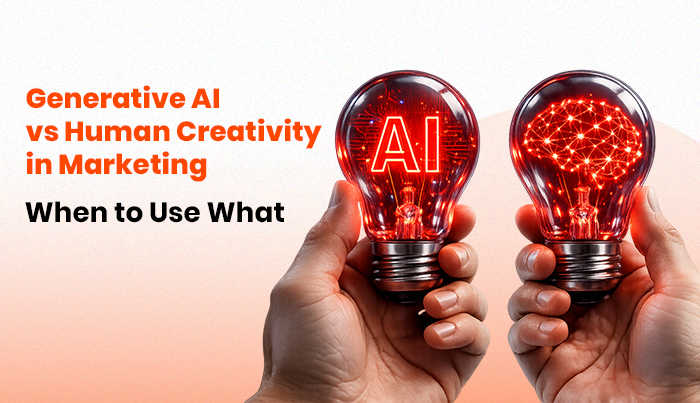
Generative AI vs Human Creativity in Marketing: When to Use What
Generative AI in marketing is no longer a trend to watch. It is already embedded in how campaigns are built, tested, and scaled. The mistake many teams make is treating it as either a magic solution or a creative threat. It is neither.
The real question is practical: what should AI handle, and what should remain human-led? If that boundary is unclear, marketing starts to feel either inefficient or generic.
Where Generative AI in Marketing Actually Adds Value
Generative AI in marketing works best when the task is operational rather than conceptual. If you need variations of ad copy for testing, AI can produce multiple options quickly. If you need structured blog outlines, keyword groupings, or data summaries, AI handles volume without fatigue.
AI content creation also speeds up production cycles. It allows teams to move from draft to refinement faster. Instead of spending hours writing first versions, marketers can review, adjust, and improve existing drafts.
This efficiency is useful for performance marketing, where campaigns require continuous testing, iteration, and adaptation. Research from Harvard Business Review shows how
generative tools increase productivity in creative workflows. The strength here is speed and pattern recognition.
Where Human Creativity in Marketing Still Matters
Human creativity in marketing becomes essential when differentiation is the goal. Brand voice, positioning, and storytelling depend on understanding context. A tool can replicate tone, but it does not understand why a certain tone works for a specific audience at a specific moment.
For example, local markets behave differently. Cultural nuances, economic shifts, and social conversations influence how messages are received. AI can assist in drafting, but it does not interpret these subtleties without detailed direction.
Creative decisions involve risk assessment as well. For example, choosing a bold campaign idea or narrowing a target audience requires crucial judgment. That judgment is shaped by experience and responsibility, not algorithms or systems.
AI vs Human Marketing Strategy: Understanding the Divide
AI vs human marketing strategy becomes clearer when looking at long-term brand decisions. AI can analyse data and suggest some opportunities. It can identify which keywords are trending or which ad variations perform better. But it does not determine brand direction over the next five years.
Strategic thinking involves deciding what a brand stands for, what it refuses to say, and how it wants to be perceived. These are not tasks of efficiency. When teams rely too much on AI for marketing in strategic direction, they’ll get lost. It’s a mix of AI plus your strategy which gives the winning moment.
The Risk of Over-Automation
One noticeable outcome of AI content creation is similarity. Many blogs, ads, and landing pages begin to sound same. Sentence structures repeat. Arguments follow predictable formats. This happens because AI learns from patterns. It produces what is statistically common.
Marketing that relies only on pattern repetition eventually loses memorability. Audiences may not consciously recognise the similarity, but they sense it. Distinct brands require human intervention to break patterns intentionally.
A Practical Way to Combine Both
Instead of debating generative AI in marketing versus human creativity in marketing, it is more useful to assign roles.
AI should support:
- Draft generation
- Research assistance
- Data summarisation
- Variation testing
For example, local markets behave differently. Cultural nuances, economic shifts, and social conversations influence how messages are received. AI can assist in drafting, but it does not interpret these subtleties without detailed direction.
Creative decisions involve risk assessment as well. For example, choosing a bold campaign idea or narrowing a target audience requires crucial judgment. That judgment is shaped by experience and responsibility, not algorithms or systems.
AI vs Human Marketing Strategy: Understanding the Divide
AI vs human marketing strategy becomes clearer when looking at long-term brand decisions. AI can analyse data and suggest some opportunities. It can identify which keywords are trending or which ad variations perform better. But it does not determine brand direction over the next five years.
Strategic thinking involves deciding what a brand stands for, what it refuses to say, and how it wants to be perceived. These are not tasks of efficiency. When teams rely too much on AI for marketing in strategic direction, they’ll get lost. It’s a mix of AI plus your strategy which gives the winning moment.
The Risk of Over-Automation
One noticeable outcome of AI content creation is similarity. Many blogs, ads, and landing pages begin to sound same. Sentence structures repeat. Arguments follow predictable formats. This happens because AI learns from patterns. It produces what is statistically common.
Marketing that relies only on pattern repetition eventually loses memorability. Audiences may not consciously recognise the similarity, but they sense it. Distinct brands require human intervention to break patterns intentionally.
A Practical Way to Combine Both
Instead of debating generative AI in marketing versus human creativity in marketing, it is more useful to assign roles.
AI should support:
- Draft generation
- Research assistance
- Data summarisation
- Variation testing
Humans should lead:
- Brand positioning
- Campaign direction
- Final tone refinement
- Long-term strategic choices
When this structure is clear, efficiency improves without sacrificing clarity.
How DT7 Approaches This Balance
At DT7, generative AI in marketing is integrated into workflow systems, not used as a replacement for thinking. Brand architecture, campaign ideas, and strategic planning will remain human-led. This ensures that automation enhances productivity without flattening differentiation. Marketing decisions decide growth and have consequences if their own.
Those consequences require accountability. And we take that on your behalf.
Closing Thought
Generative AI in marketing is powerful because it accelerates production. Human creativity in marketing remains powerful because it shapes meaning. The teams that succeed will not treat this as a competition. They will treat AI as infrastructure and creativity as direction.
Tools improve output. Judgment builds brands.